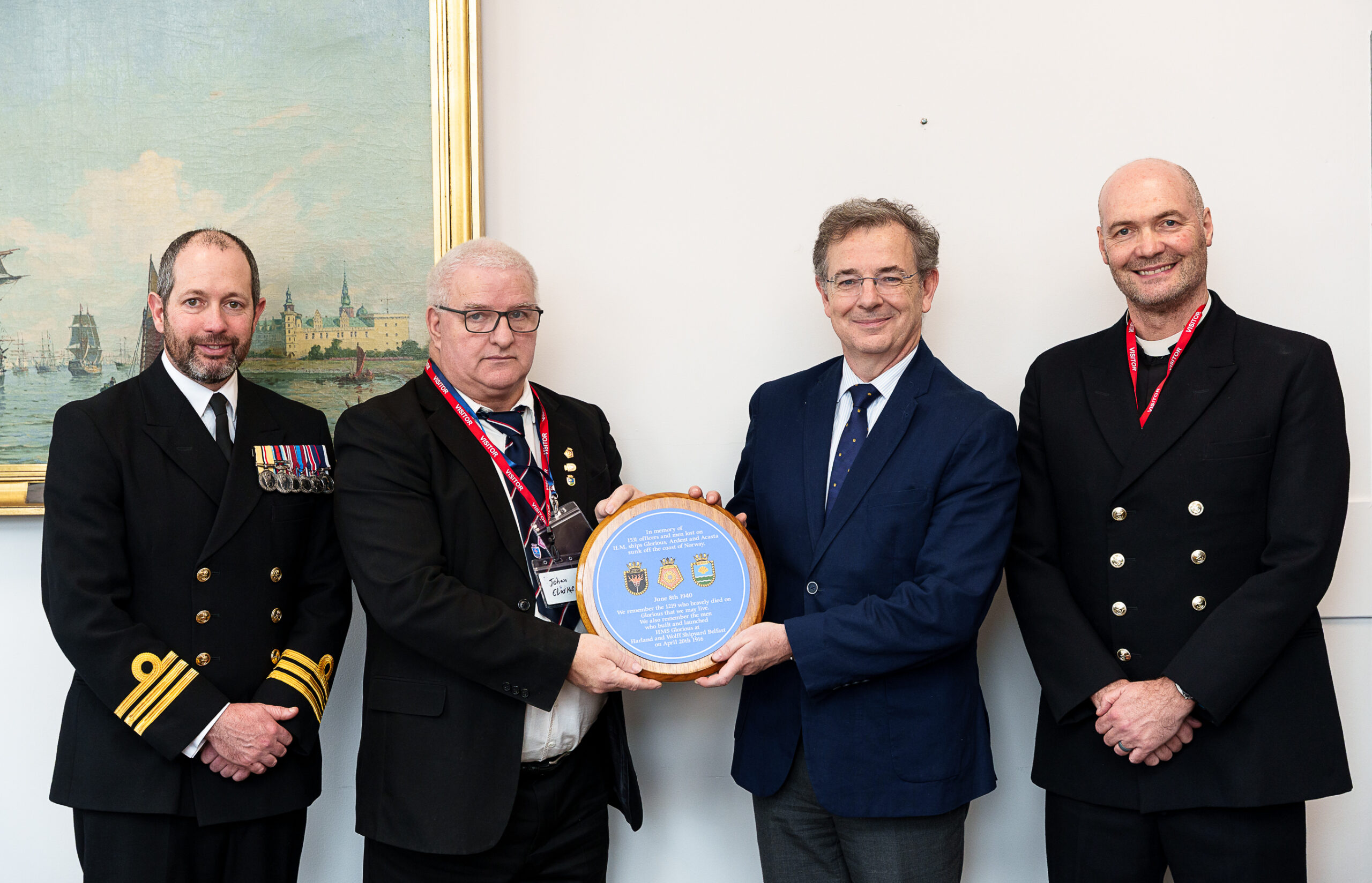
Navantia UK has presented a plaque honouring the memory of HMS Glorious, HMS Ardent and HMS Acasta at its Harland & Wolff shipyard in Belfast, the very place where HMS Glorious was built over a century ago.
The plaque, presented during a commemoration ceremony on Thursday, pays tribute to the aircraft carrier and her two escort destroyers which were sunk in June 1940 during the Norwegian campaign. The tragedy resulted in the loss of 1,519 lives.
HMS Glorious was built at Harland & Wolff as a large light cruiser and commissioned in January 1917. She was converted into an aircraft carrier at Rosyth in 1924 and went on to serve with the Mediterranean fleet. At the outbreak of the Second World War, following a spell in the Indian Ocean, she was recalled to the Home Fleet in April 1940 to provide air cover for British forces in Norway. In early June she returned to Norwegian waters to support the evacuation of British troops under Operation Alphabet but was intercepted by the German battleships Scharnhorst and Gneisenau. All three Royal Navy ships were lost.
During the ceremony, the commemorative plaque designed by the HMS Glorious, Ardent and Acasta Association – known as the GlArAc Association – was presented. A short service was presided over by a Royal Navy chaplain, with members of the association joined by Royal Navy personnel, Royal Naval Association veterans and Harland & Wolff employees. The shipyard then hosted a guided tour for the veterans and guests in attendance.
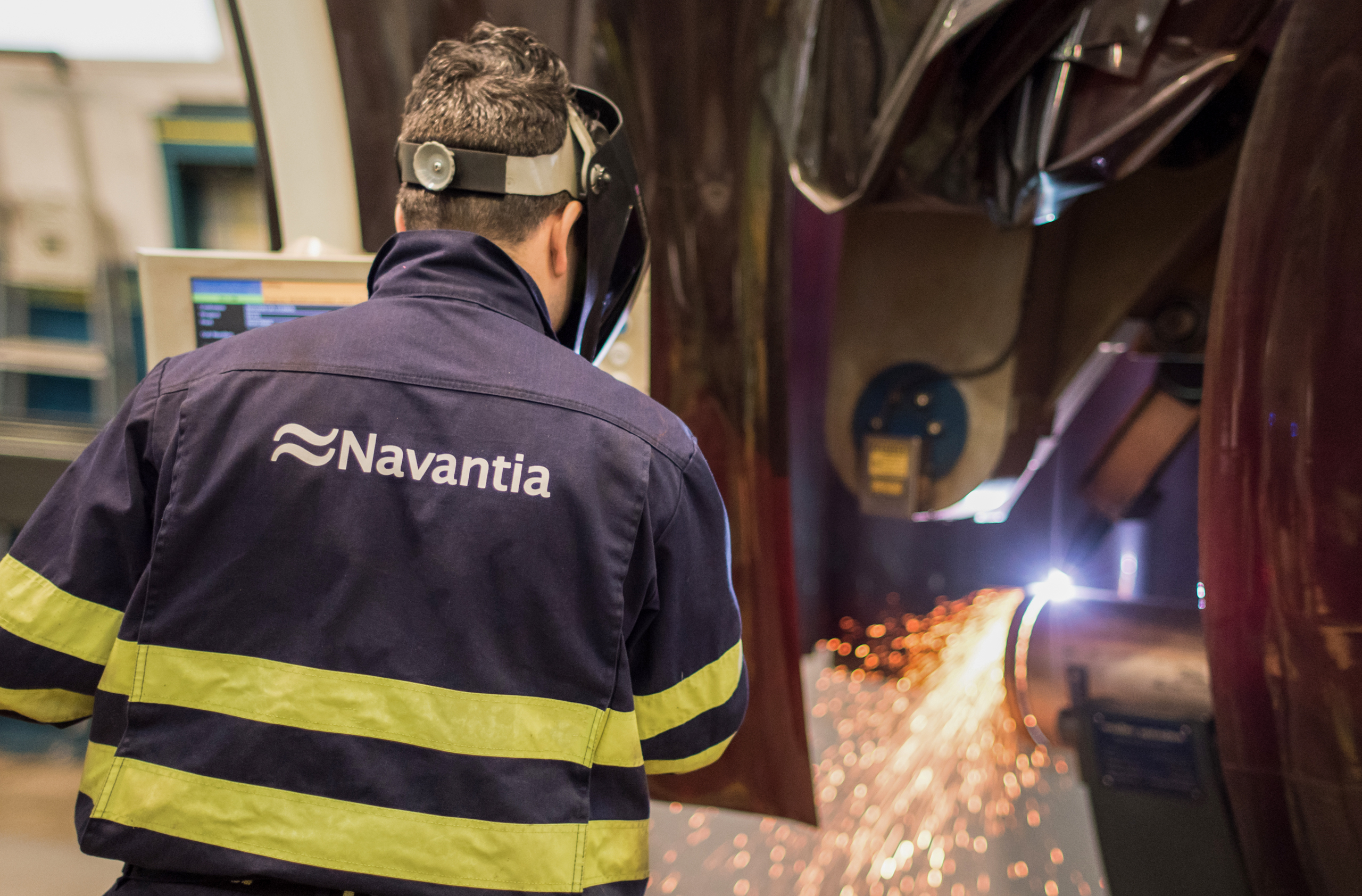
The commemoration comes as the Belfast yard undergoes a major transformation under Navantia UK, which acquired Harland & Wolff in January 2025. The shipyard is receiving over £90 million in investment as part of a wider £115 million programme across Navantia UK’s four sites, and is playing a central role in the Fleet Solid Support programme – a new class of Royal Fleet Auxiliary ship. A new advanced panel line is currently being installed that will make Harland & Wolff one of the most capable shipbuilding facilities in Europe.
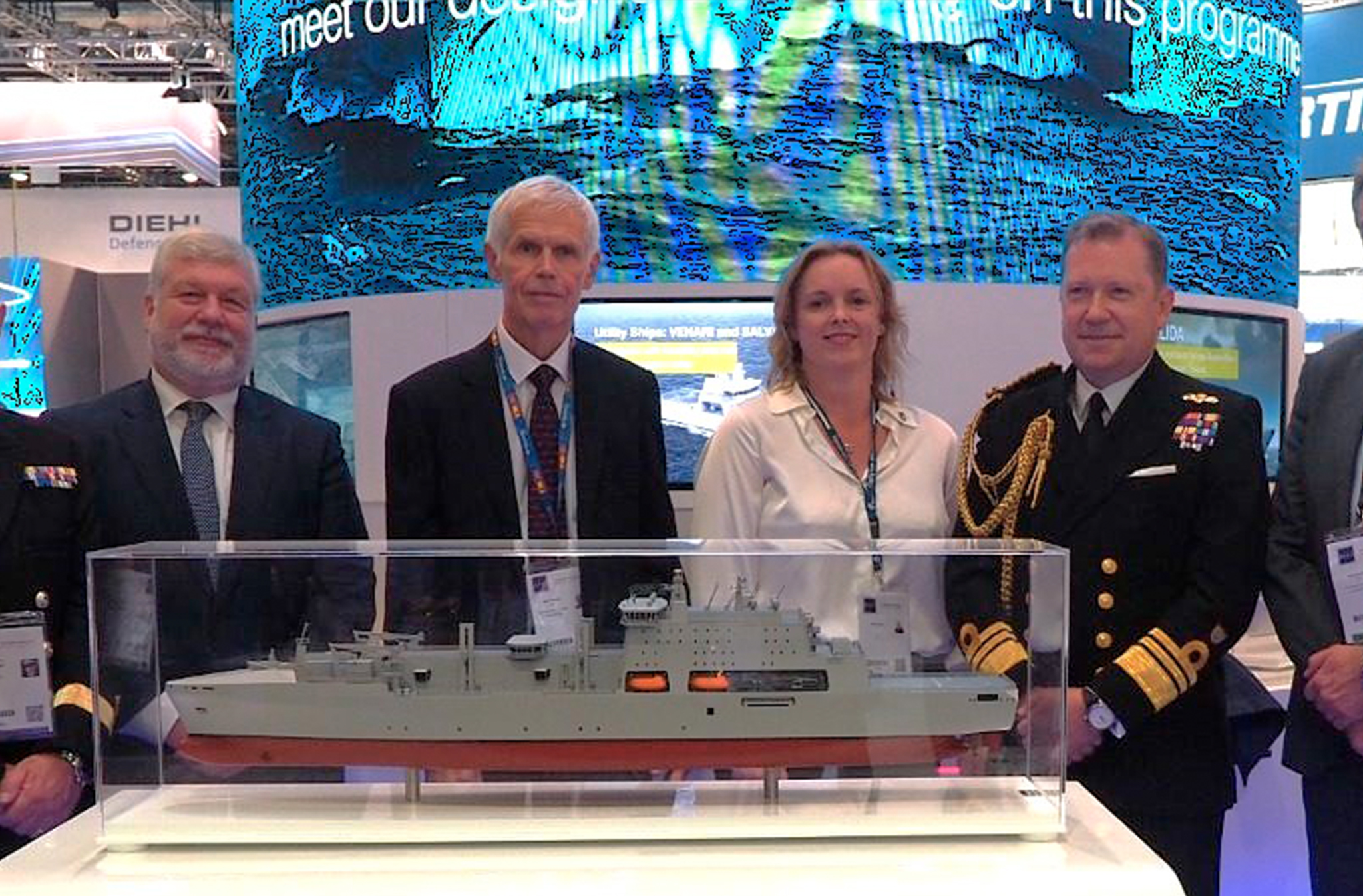
The FSS ships, at 216 metres long and with a displacement of 39,000 tonnes, will be the second largest vessels in UK defence after the aircraft carriers. Modules are being built across Navantia UK’s yards in Appledore and Belfast, alongside Navantia’s shipyards in Spain, ahead of final assembly, testing and delivery in Belfast. The first ship has been named RFA Resurgent.
Today’s ceremony offered a moment to reflect on the shipyard’s deep roots in naval history, even as it looks ahead to the next generation of ships that will be built on the same Queen’s Island site.
Donato Martínez, CEO of Navantia UK, said: “It is a profound honour to unveil this plaque at the very yard where HMS Glorious was built more than a century ago. We remember the 1,519 sailors who lost their lives alongside HMS Ardent and HMS Acasta, and we pay tribute to their service and sacrifice. Harland & Wolff has played an important role in the story of the Royal Navy, and it is right that we pause to reflect on that legacy. As Navantia UK invests in the future of this yard and delivers the Fleet Solid Support ships for the Royal Fleet Auxiliary, we are conscious that we are writing the next chapter on the same historic ground. Our commitment is to honour that heritage through the quality of the ships we build and the long-term industrial capability we are restoring here in Belfast.”